
 |
 |
 |
 |
 |

|
Katie Harrow summarizes the timeline for the development of writing in Eurasia.
6,000 years ago:
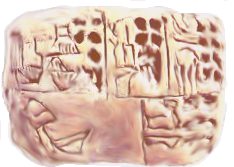
Pictograms (pictures whose meaning is directly related to the image: eg. a snake means a snake) were in use in Egypt and Mesopotamia. These evolved into Hieroglyphics when the meanings came to include verbs (image of an eye might now also mean 'too see something') and phonetics, (the snake image could mean an 'ess' sound).
 It
is no coincidence that we see the emergence of advanced written language in
places like Egypt and the city states of the Tigris and Euphrates. The people
here were no cleverer than their rural cousins, but their need to orderly
record and store information increased as the cities grew and this provided
the impetus to improve their writing systems. These in turn may have provided
the capacity for further growth which would have been impossible without writing.
It
is no coincidence that we see the emergence of advanced written language in
places like Egypt and the city states of the Tigris and Euphrates. The people
here were no cleverer than their rural cousins, but their need to orderly
record and store information increased as the cities grew and this provided
the impetus to improve their writing systems. These in turn may have provided
the capacity for further growth which would have been impossible without writing.
Archaeology shows us a clear evolution from pictograms to cuneform from excavations of Uruk in Mesopotamia where the earliest cunefom are simply pictograms rotated through 90 degrees, formed of wedge shapes marks pressed into soft clay. Over time these become more and more stylised.
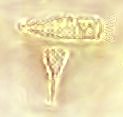 5,000
years ago in Egypt, the name of the early Pharoh NARMER was written on a palette
using two images: A cuttlefish (NAR) and a drill or chisel (MR)(1). Names
of the Pharohs were later always placed in a specific border known as a cartouche.
5,000
years ago in Egypt, the name of the early Pharoh NARMER was written on a palette
using two images: A cuttlefish (NAR) and a drill or chisel (MR)(1). Names
of the Pharohs were later always placed in a specific border known as a cartouche.
The Narmer Palette from Hierakonpolis is in the Cairo Museum ref: JE32169
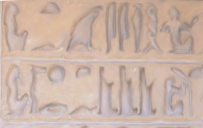 The
Egyptian Heiroglyphics included 'ideograms' where single images stood for
whole words as well as images standing for sylables. They also had alphabet
signs which were useful when a new word was needed. Foreigners names were
often spelled out using these particular 'alphabet heiroglyphs'.
The
Egyptian Heiroglyphics included 'ideograms' where single images stood for
whole words as well as images standing for sylables. They also had alphabet
signs which were useful when a new word was needed. Foreigners names were
often spelled out using these particular 'alphabet heiroglyphs'.
The ancient Egyptians used their heiroglyphics not only as information storage, but also as decoration, which leaves archaeology and history with a fabulous wealth of written data about the wars, politics, beliefs and daily lives of the peoples of the Nile.
 3,600
years ago:
3,600
years ago:
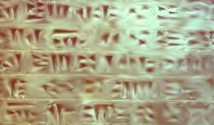
In the Levant, The Hyksos, Hittites, Canaanites and other groups are all writing in variations of cuneform scripts which had evolved from pictograms.
 (press F5 key for animation)
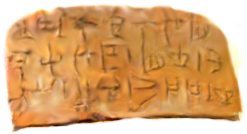 3400
years ago, invaders from the east brought linear-a script to south western
europe. In time this evolved through linear B into Ancient Greek. In the west,
we use a variant of the greek alphabet today . Our numbering system comes
from Arabic.
3400
years ago, invaders from the east brought linear-a script to south western
europe. In time this evolved through linear B into Ancient Greek. In the west,
we use a variant of the greek alphabet today . Our numbering system comes
from Arabic.
Katie 2003
References:
1 http://www.historian.net/hxwrite.htm
2 http://www.wam.umd.edu/~rfradkin/alphapage.html
Copyright 2002-2005 newarchaeology.com Hosted by 1&1.co.uk