
 |
 |
 |
 |
 |

|
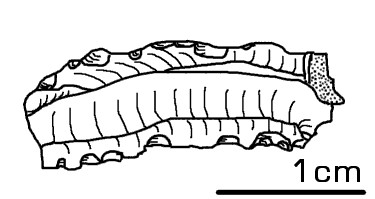
How to recognize prehistoric stone toolsStone is very hard wearing, so when a tool is accidentally dropped or thrown away, it just sits on the ground. It can take tens of thousands of years before a tool becomes so weathered that it is unrecogniseable. Therefore, if you are in an area where humans lived in prehistoric times you can, with a little luck and patience find and recognise stone artifacts yourself. Hominids have been making tools for about half a million years, so there is quite a lot of it about if you know where to look. Not convinced? Consider this... A flat plateau at the top of a slope overlooking a wide expanse of the Thames valley (Berkshire, England) is very deireable real estate today and has been desireable for about 5000 years. For 4000 of those years, the local population used stone tools. Edges wear down very quickly so lets estimate a family made one new blade, scraper, spear point or arrowhead each week. This means that over 200,000 tools were made and thrown away. Since there was no rubbish disposal back then, it is a very fair bet that these tools are all still there within a stones throw of the plateau. Ok, so how do we find them? Well that is largely a matter of tuning in to the environment and the usual modes of human behavior. When working outside, we usually sit facing downhill, particularly if the view is good. That is also the direction we throw rubbish. Thinking about this sort of thing will allow us to narrow our search area. Lets walk about halfway down the slope to where it levels out again. So we now have a much smaller location where we can guess there must be about 100,000 flint tools. Next, we wait for the farmer to plough it up. Then we get permission to hunt for stone tools. Then we wait for rain followed by a break in the weather. Stone tools show up better after the rain has given them a wash. Start walking slowly across the site looking for anything 'odd'. Basically you are looking for the shine of a broken piece of flint. A glassy finish is the first sign that a stone has been broken. Unfortunately, frost will crack a flintstone, so just because it is shiny, doesn't mean it is a tool. Pick up the stone and have a closer look. If you find a number of faces (flat surfaces) caused by percussive blows then you have probably found an artifact. The best way to discover what a percussive blow looks like is to get a big bit of flint and practice on it. You will soon see the destinctive way that flint breaks when you hit it. Mesolithic bladelet from Thames Valley (near Reading, Berkshire)
Find out about how it was made.
|
Subscribe to our free newarchaeology.com email newsletter. Copyright 2002 newarchaeology.com Hosted by 1&1.co.uk